Wedding Entertainment in Hobart: What Tasmanian Couples Actually Need to Know
You've got the venue locked in. Maybe it's a rustic barn in the Coal River Valley, a vineyard outside Richmond, or somewhere so far off the beaten track that your photographer needed a GPS and a full tank of fuel just to find it. The dress is sorted, the celebrant booked, and now you're staring at a line item on the spreadsheet that says "entertainment" and wondering how much it should cost, who to book, and whether your cousin's Spotify playlist could just do the job instead.
Short answer: it could, but it almost certainly shouldn't. Longer answer below -Wedding entertainment in Hobart is a small, tight market with some genuine quirks: the geography, the venues, the weather, and the fact that everyone in the local industry seems to know everyone else. Here's what actually matters when you're booking.
Why Hobart weddings are different from mainland weddings?
Isaac Westwood - Hobart Wedding Musician
A wedding in Hobart isn't the same gig as a wedding in Sydney or Melbourne. Three things make the planning logistics distinct:
The weather has opinions.
Tasmania does four seasons in a day better than most places do four seasons in a year. A solid wedding entertainer needs an indoor backup plan, weather-resistant equipment, and the flexibility to shift locations 90 minutes before the ceremony if the southerly comes in.
Travel is part of the package.
Most wedding venues are 30–90 minutes from central Hobart. Saffire Freycinet is a four-hour round trip from town. Cradle Mountain weddings involve an overnight stay for the entertainment team. This affects pricing in ways that genuinely surprise couples coming from interstate.
Power isn't a given.
Power isn't a given. Some of Tasmania's most spectacular ceremony locations, (forest clearings deep in the Tarkine, myrtle rainforest on the edge of a national park, a private property at the end of a dirt road that Google Maps gives up on) don't have mains power anywhere near them. A generator can bridge the gap for a larger reception setup, but nobody books a rainforest ceremony so they can say their vows over the sound of a 5 horsepower petrol engine. The better answer is battery-powered equipment, and the good news is that the technology has caught up! A quality battery rig now delivers the same sound as a mains setup without the noise, the fumes, or the cable run across the ceremony space. Just make sure whoever you book actually carries it, if it is a requirement for your ceremony.
What "wedding entertainment" actually covers:
Nikayla & Tom - Hobart Wedding Duo (Tom Booth Music)
When most people say "wedding entertainment" they're usually thinking about the reception DJ. But across an average Tasmanian wedding day, you're really booking music for four distinct moments:
Ceremony - Guest arrival background music, processional, signing of the register, recessional. Usually 45-60 minutes total.
Canapés / pre-reception - Relaxed live music while guests mingle and the wedding party does photos. Around 60–90 minutes.
Reception dinner - Quieter background music between speeches and during meals. Two to three hours.
Dancefloor - The actual party. Three to four hours.
Each of these has different acoustic requirements, different energy levels, and ideally different musical approaches. The all-in-one packages that have become popular in Hobart exist because juggling separate suppliers for each segment can be a planning nightmare.
What it actually costs in Hobart:
Industry data is patchy, but based on what's publicly visible from Tasmanian wedding suppliers and broader Australian benchmarks (The Wedding Industry's annual reports, Easy Weddings' supplier pricing data), here's the rough lay of the land for 2026:
- Solo acoustic ceremony performer: $700–$1,200 for ceremony only
- Acoustic duo for ceremony + canapés: $1,400–$2,200
- Wedding DJ for reception only: $1,300–$2,800
- Combined live music + DJ all-day package: $3,000–$5,500
- Premium full-band reception: $4,000–$8,000+
Chaskii - Acoustic Wedding Duo Hobart
Going cheaper than those ranges almost always costs you somewhere on the day: speakers that don't fill the room, no backup gear if something fails, performers who are still figuring out how weddings actually run. Beyond the base rate, travel makes a bigger difference than most couples expect. A reception in central Hobart and a ceremony at Pumphouse Point are completely different logistical propositions, and any supplier quoting the same flat rate for both is either cutting corners on one or padding the other. That's why many experienced local entertainers won't publish fixed prices. A quote that actually means something needs to know where you're getting married first.
What's trending in the local market right now?
A few shifts are worth knowing about because they'll affect what you're being offered:
The hybrid acoustic-to-DJ format has won.
Five years ago you'd book a separate acoustic act and a separate DJ. Now most established Hobart entertainers offer a single-supplier package that runs ceremony → canapés → dinner → dancefloor as one continuous handover. Couples like it because it's one contract, one point of contact, one setup. Suppliers like it because it's a higher-value booking
Sax-with-DJ is having a moment.
Live saxophone played over DJ sets — a trend that started in Melbourne club culture — has crossed into the Tasmanian wedding market. It's a way to get the energy of a live act without the cost of a full band. Expect to pay roughly $600–$900 on top of a standard DJ package for a one-hour sax feature set.
Recording is quietly becoming its own thing in the Tasmanian wedding market.
Recording the ceremony songs, capturing the reception speeches, even the entire ceremony (if the celebrant is on-board). This is increasingly something couples ask about, and some local entertainers have started including it as a standard add-on. For couples working with a videographer, a clean dedicated audio feed mixed into the final film is a completely different product to whatever the camera mic picked up from six rows back. Another interesting development is custom studio song recordings: a couple's first-dance song or processional recorded by a local musician in their own voice, produced specifically for that wedding. It sits somewhere between a keepsake and a gift, and it's the kind of thing that barely existed as a formal offering in the Tasmanian market until very recently.
Personalisation has gone deep on the DJ side especially.
Couples increasingly want a set that reflects how they actually listen to music — not a generic sweep through the wedding DJ playbook. The better DJs will spend real time with you before the day, building a picture of your taste, your guests, the energy you want at 10pm versus midnight. It goes beyond a do-not-play list. The difference between a DJ who's done that homework and one who hasn't is obvious within the first twenty minutes of the reception
Battery-powered, off-grid setups have gone from niche to normal surprisingly quickly.
Battery-powered, off-grid setups have gone from niche to normal surprisingly quickly. Three or four years ago it was a genuine point of difference; now it's something most established Hobart wedding suppliers either already have or are actively investing in. If you're planning a ceremony somewhere without mains power, it's worth asking the question early, just so everyone's on the same page about what the setup actually requires.
A realistic Hobart wedding-day timeline:
Here's how a typical Tasmanian wedding actually flows, music-wise. Useful for understanding what you're paying for:
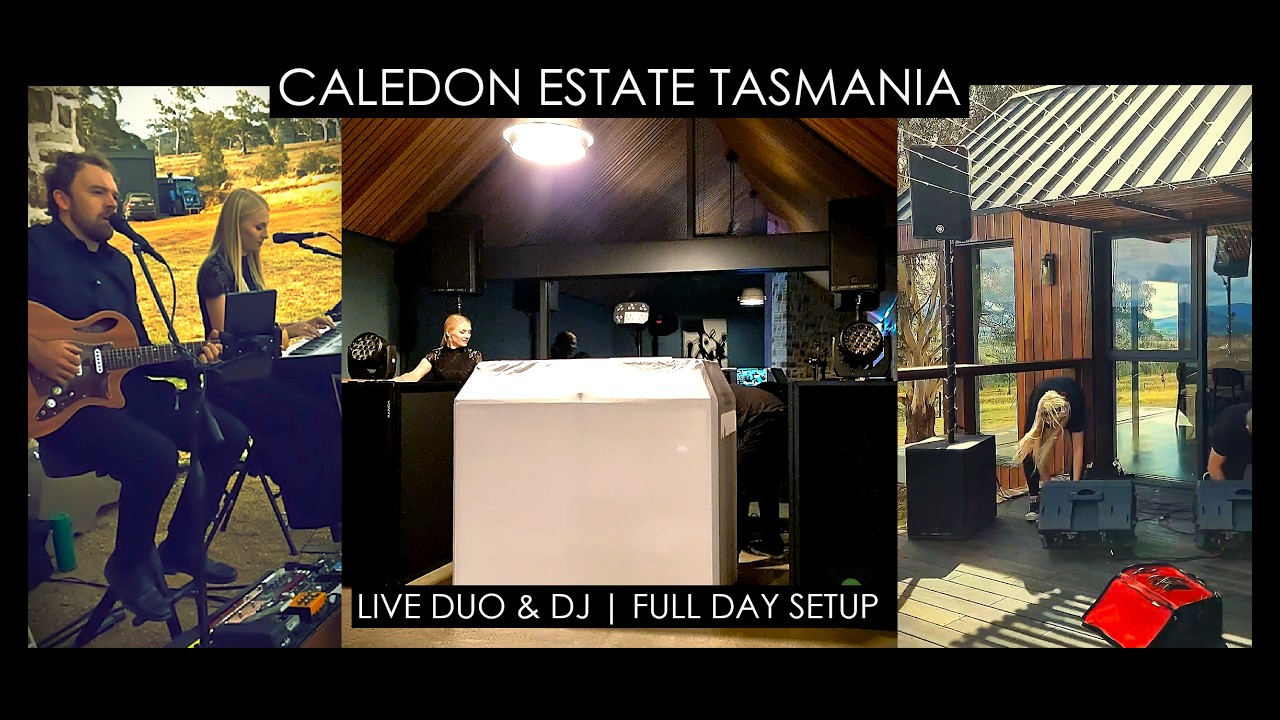
- 10:30 am: The day starts. Reception venue first: DJ booth goes up, main PA gets tested, and if canapés are happening in a separate part of the same property, a second PA goes up there too. That second system means no awkward pack-down and scramble mid-afternoon when guests are milling around with drinks.
- Early afternoon: Drive to ceremony location if it's a separate venue, or move to the ceremony area on-site. Battery-powered setup goes in, plugged into mains if it's available, running on battery if it isn't.
- 2:30 pm: Guests arrive to live acoustic background music.
- 3:00–3:30 pm: Ceremony: processional song as the bridal party walks in, live music during the signing of the register, recessional song as the couple walk out together.
- 3:45–5:30 pm: Canapés, live acoustic music, golden-hour photos.
- 6:00 pm: Bridal Party Entrance Song - Performed live or from the DJ Booth, sometimes co-ordinated with announcements from the MC.
- 6:15-8:15: Dinner, speeches and cake cutting. Live music continues between formalities.
- 8:30 pm: DJ set begins. Starting with the first dance, then the dancefloor opens.
- 11:30 pm: Last song. Then pack-down begins.
- 2:00 am: Home.
That's a fifteen-hour day, 2-3 PA systems, and in many cases two distinct locations. When suppliers quote $3,500+ for an all-in-one package, that's the reality being priced.
Video can’t be displayed
The most common mistakes Hobart couples make:
A few patterns that come up repeatedly:
- Booking too late. Peak season runs October through April. The well-regarded local musicians are typically booked 12 months out for Saturday weddings in February or March. Friday and Sunday weddings, and off-season weddings (June–August), have far better availability.
- Not briefing the entertainer on guest demographics. A room of 60-year-olds and a room of 30-year-olds need completely different approaches to the dancefloor, and a good DJ will ask, but not all of them do
- No MC plan. Either the DJ MCs (cheaper, sometimes works), the celebrant doubles up (rarely works), or you book a separate MC (more expensive). Decide early.
- Not having a clear end-of-night plan. Who signals the last song? How does the venue know it's wrapping up? Where are guests going afterwards. Endings that aren't planned lead to confusion and tend to just fizzle.
- Confusing "DJ" with "wedding DJ". A great club DJ and a great wedding DJ are both skilled at what they do, the jobs just ask for very different things. One is reading a room that wants to dance. The other is running a structured timeline, coordinating with a photographer and a venue, and keeping three generations of guests happy across a six-hour reception.
How to actually choose someone:
There's no perfect checklist here, but a few things are worth paying attention to:
- Look for wedding-specific experience. Live performance experience is great, but weddings have a particular rhythm and set of pressures that take time to learn. It's reasonable to ask how many weddings someone has done and whether they do them regularly.
- Look for long-form content, not just highlight reels. A polished Instagram clip tells you very little. A longer video from an actual wedding — even just a few minutes of unedited footage — gives you a much better sense of how someone performs in a real setting with real acoustics and a real crowd.
- Ask about backup plans. Gear fails occasionally. It's not a trick question — any experienced supplier will have thought about this and have a straightforward answer.
- Get a written quote with the key inclusions noted. Not every supplier offers the same things, and assumptions on both sides are where misunderstandings happen. Travel, lighting, MC duties — worth clarifying upfront rather than after you've signed anything.
- Ask if they've played your venue. Tasmania's wedding industry is small and well-connected. There's a reasonable chance they have, and if so, they'll know things about the space that don't show up anywhere online.
- Check recent Google reviews. Testimonials on a website are curated by definition. Reviews from the last twelve months on Google give you a more unfiltered picture.
Why local matters more than you'd think:
- There's a temptation, especially for couples flying in from Melbourne or Sydney for a destination Tasmanian wedding, to bring suppliers across with them. It almost never works out cheaper, and it usually costs you on the day. Local musicians know the venues, the celebrants, the photographers, the catering teams, the parking situations, and the weather patterns. They've problem-solved your exact scenario before. That institutional knowledge is genuinely valuable and isn't reflected on the price sheet.
- Hobart's wedding music scene is small enough that the working professionals know each other, refer work to each other, and cover for each other when things go sideways. That network is the thing you're really hiring.
If you're starting to plan music for a Hobart or Tasmanian wedding, the single most useful thing you can do this week is reach out to two or three local musicians with your date, your venue, and a rough sense of the vibe you're after. Have a fifteen-minute conversation. The good ones will tell you honestly whether you're a fit, what they'd recommend for your venue, and where your budget is best spent. That conversation alone — even before you book anyone — will tell you more about how the day will run than any number of Pinterest boards.Tasmania does weddings beautifully, but only when the music holds the day together. Find someone local, book them early, and let them do the job they've spent years learning to do.
If you think a seamless acoustic-to-DJ package might be the right fit for your day, let's start planning. Read more about my hybrid package, or grab a custom quote by filling out my online form.